
Dr. Nikita Sharma
Published on January 24, 2026
Beyond the Thumb: Understanding Its Impact on Your Child's Smile | Dr. Nikita Sharma
Thumb Sucking and Dental Health: A Guide for Concerned Parents
Greetings to all the attentive parents in Ajmer! I'm Dr. Nikita Sharma, a Pediatric Dentist at Nivik Smile Care. Today, let's talk about a very common, instinctive habit in children—thumb sucking. While it's a natural source of comfort, many parents in my Ajmer clinic ask me, "When should we be worried?" Let's navigate this topic together, separating myth from fact and understanding its real impact on developing teeth.
Why Do Children Suck Their Thumbs? It's More Than Just a Habit
Thumb sucking is a reflexive, self-soothing behavior that begins in infancy. It provides a sense of security, happiness, and can even help children fall asleep. For babies and toddlers, it's a completely normal part of development. The concern arises not from the habit itself, but from its duration, intensity, and frequency as your child grows.
When Does Thumb Sucking Become a Dental Problem?
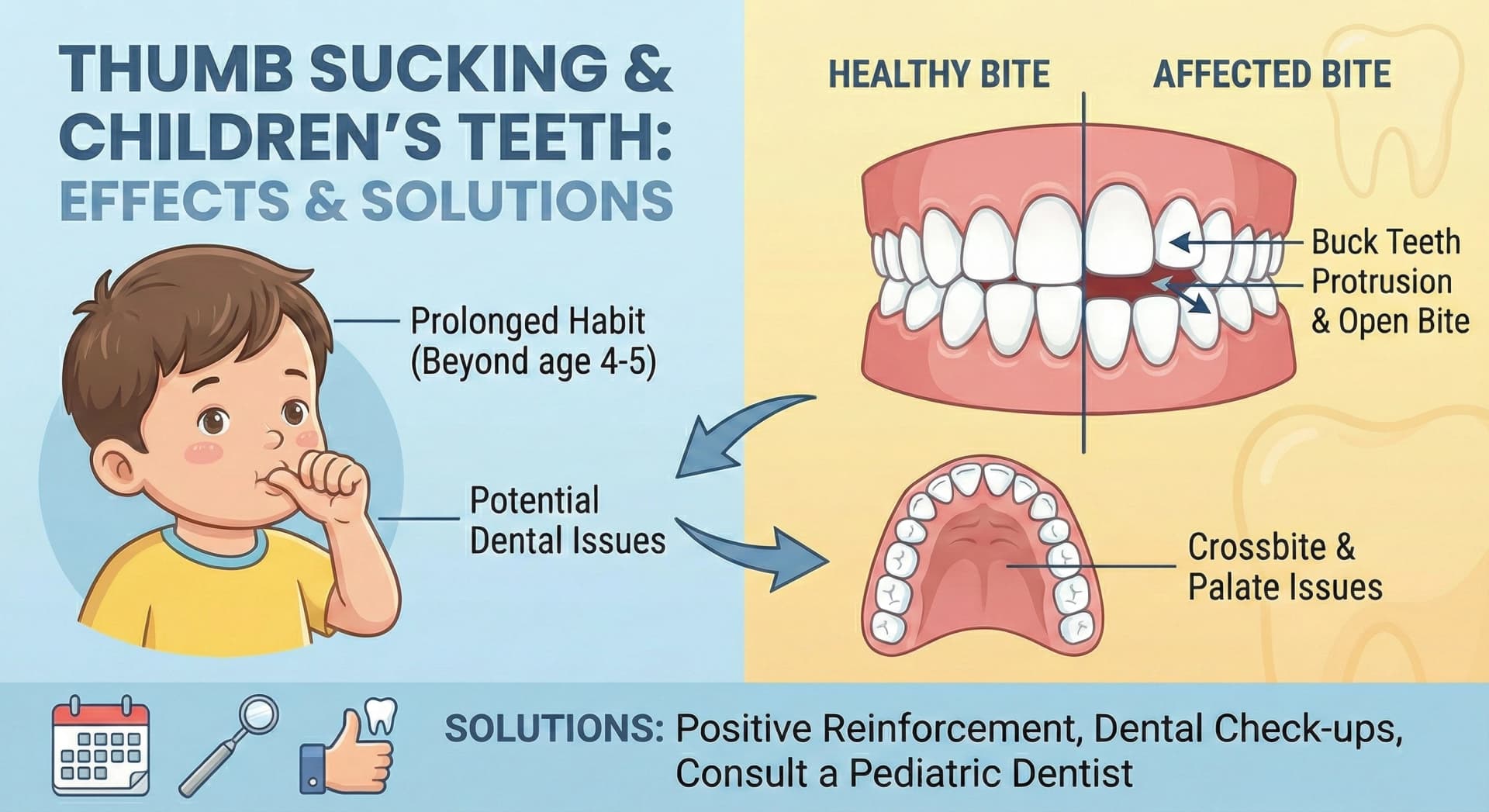
The key factor is age. Most children naturally stop between the ages of 2 and 4. As a pediatric dentist, my concern grows if the habit persists beyond the age of 4 or 5, when the permanent teeth are beginning to prepare for their eruption. Prolonged and vigorous sucking exerts constant pressure on teeth and jaws, which are still soft and malleable.
The Direct Effects on Teeth and Jaw Development
Persistent thumb sucking can lead to several orthodontic and dental issues, often referred to as 'Malocclusion' or a bad bite. Here’s what we commonly see:
| Dental Issue | What It Looks Like | Long-Term Concern |
|---|---|---|
| Open Bite | The most common effect. The front top and bottom teeth do not meet when the back teeth are closed, leaving a visible gap. | Can affect biting (e.g., biting into an apple), speech (like lisping on 's' and 'z' sounds), and facial appearance. |
| Overjet (Protruded Front Teeth) | The upper front teeth push outward, becoming excessively prominent. | Increases the risk of trauma and fracture to these front teeth from falls or accidents. |
| Crossbite | The upper teeth bite inside the lower teeth, affecting the width of the upper jaw. | Can lead to asymmetrical jaw growth and uneven wear of tooth enamel. |
| Speech Problems | Difficulty articulating certain sounds like /s/, /z/, /t/, /d/, /l/, /th/. | May require speech therapy in addition to dental correction. |
Age-by-Age Guide: From Soothing to Stopping
Infancy to 2 Years (The Soothing Phase):
- This is typically harmless. Focus on offering comfort in other ways but avoid making it a battle.
- Keep the thumb clean to prevent infections.
Ages 2-4 (The Weaning Phase):
- Gently encourage cessation. Praise your child when they are not sucking.
- Identify triggers (boredom, tiredness) and offer alternatives like a hug, stuffed toy, or engaging activity.
- Use positive reinforcement charts with stickers for thumb-free days.
Ages 4+ (The Intervention Phase):
- If the habit continues, it's time for a more proactive approach.
- Have a calm, positive talk with your child about being a "big kid."
- Consult your pediatric dentist. We can provide encouraging advice and explain the effects to your child in a friendly, non-scary way.
Gentle Strategies to Help Your Child Stop (What Works in Ajmer Homes)
Nagging or punishment often backfires. Instead, try these positive methods:
1. Open Communication: Use books or stories about kids who stop thumb sucking. Explain how teeth grow straight and strong when the thumb doesn't push them.
2. Positive Reinforcement: Celebrate small victories! A sticker chart leading to a non-food reward (like a trip to the park) can be highly motivating.
3. Identify and Distract: Notice when the habit is most frequent. If it's during TV time, give them a fidget toy or play-dough to keep hands busy.
4. Use Reminders, Not Barriers: For older, motivated children, a bitter-tasting (but safe) thumb guard or a bandage on the thumb can serve as a gentle reminder, not a punishment.
5. Seek Professional Support: At Nivik Smile Care, we act as a supportive coach. Sometimes, a few encouraging words from "Dr. Nikita" about keeping teeth healthy can work wonders!
Thumb Sucking vs. Pacifier Use: Which is Better?
Parents often ask this. While both can cause similar dental issues if used too long, a pacifier has one slight advantage: you can take it away. You can control and eventually discard a pacifier, but a thumb is always attached. The American Academy of Pediatric Dentistry recommends weaning from a pacifier by age 3.
Will The Effects Correct Themselves?
This depends. If the habit stops before the permanent front teeth erupt (around age 6-7), there's a good chance the bite can self-correct with normal growth and tongue pressure. If the habit persists after this, orthodontic treatment (braces or other appliances) will likely be needed in the future to correct the misalignment. Early intervention is key to preventing complex treatments later.
Common Concerns from Ajmer Parents Answered
"My 5-year-old only sucks their thumb at night. Is that a problem?"
Nighttime habits can be just as impactful because the pressure is sustained for hours. We recommend focusing on positive reinforcement during the day and considering a gentle reminder like mittens or socks on hands at night, with your child's agreement.
"Should I use a thumb guard or appliance?"
Dental appliances (like a palatal crib) are a last resort for persistent, damaging habits in older children. They are fixed to the teeth and act as a physical reminder. We only recommend these after other positive methods have failed and the child is cooperative, as they require excellent oral hygiene.
"I sucked my thumb and my teeth are fine. Why worry for my child?"
Every child is different! The impact depends on the intensity of sucking (passive resting vs. vigorous sucking), the position of the thumb, facial growth patterns, and genetic predisposition. It's always best to have a professional evaluation.
Your Action Plan: When to Visit Your Pediatric Dentist in Ajmer
Don't wait for visible problems. Schedule a consultation at Nivik Smile Care if:
- The habit continues past age 4-5.
- You notice visible changes in tooth alignment or jaw shape (like an open bite).
- Your child's speech is affected.
- You feel stressed about the habit and need expert, child-friendly guidance.
During the visit, we will assess your child's dental development, discuss the habit's impact visually, and create a personalized, positive plan to help them stop.
Final Reassurance from Your Pediatric Dentist
Please remember, thumb sucking is a common challenge, and shaming a child never helps. With patience, positivity, and timely professional guidance, most children can successfully leave the habit behind. Our goal is to protect your child's smile while ensuring they feel supported and confident throughout the process.
For more personalized advice on habits or other pediatric dental concerns in Ajmer, I am here to help.
Let's work together for a healthy, straight, and happy smile. Book a consultation today.
📞 Call for Appointments: +91 79761 22545
📍 Clinic 1: Paras Urology & Multispeciality Hospital, Haribhau Upadhyay Nagar, C-Block, Pushkar Road, Ajmer (10:00 AM - 12:00 PM)
📍 Clinic 2: Home, B-455 Panchsheel, B Block, Ajmer, Rajasthan (5:00 PM - 7:00 PM)
🌐 Website: https://drnikitasharma.in/